Growing Edges
  • Home
  • Wisdom Stories
    • Brother Bear >
      • River
      • Desert Stream
      • Raft
      • 4 Seasons
      • Guest Ghost House
      • Bamboo
      • Kintsugi
      • Sea of Life
      • Facing Fear
      • Oak Tree
      • Fearful Candle
      • Still Small Voice
      • 4 Elements
      • Butterfly
      • Carrot Egg Coffee
      • Four Candles
      • Bottle
      • Time and Love
      • Maybe
      • Dam
      • Tigers
      • World Mirrors the Heart
      • Prodigal Son
      • Prism & Rainbows
      • The Lotus
    • Leaven
    • Samurai & Monk
    • Fish Searching the Ocean
    • Great Pearl
    • Labyrinth
    • The Woodcarver
    • Good Shepherd
    • Peace in Stormy Sea
    • Milk to Butter
    • Dragon
    • Sower
    • Cracked Jar
    • Mustard Seed
    • The Well
    • Tea
    • Golden Cage
    • Four Directions
    • Train of Life
    • Two Wolves
    • Samaritan
    • Oak and Bamboo
    • A Meadowlark
    • Dry Bones
    • Table
    • Angry Man
  • Chaplaincy
    • Healthcare Staff >
      • When to call a chaplain
      • Spiritual Care for Staff
      • Spirituality
      • Resilience Resource
      • Grief Resources >
        • Grief & the Pandemic
      • Breathe
      • Chaplain's Tea
      • Prayers for Staff
      • Silent Prayer
      • Prayer Requests
      • Blessing of Hands
      • Blessing of Workspace
      • Imposition of Ashes
      • Holiday Box Project
    • Resources for Spiritual Care Groups >
      • Learning Modules
      • Art Projects >
        • Healing Hands Mandala
      • Mindful Gestures
      • Community Singing >
        • Healing Breath
      • Highs & Lows Ritual
  • Art & Music
    • Prayer Chants
    • Van Gogh Spirituality
    • Couple Resources >
      • Couples Class >
        • Prepare Enrich Class

Bangka Blog

On Being a Good Host to Our Grief

1/1/2020

 
In my previous blog post, I claimed that that part of the reason for why we tell and retell stories about those who have died has to do with the healing act of remembering. By putting up ofrendas in honor of our loved ones and by retelling the story about their lives (just like in the Disney's children's animated movie Coco), we are able to reconnect with them again in the present moment. However, there is also another reason for the significance of why we remember and honor the memory of those who have died. And that is to become a good host to our grief. 
Picture
There is a phase in the grief process called “disorientation,” which is also known as the “pits.” Disorientation is the most difficult phase to go through because we are disoriented. We feel lost and confused. We are not fully functional the way we used to be. We are mentally unfocused, spacey and tend to forget. Most importantly, this is a period when we experience the very intense painful feelings: deep sadness, or grief bursts, or overwhelming anger, or perhaps incapacitating guilt, or fear.

Picture
​These painful feelings come knocking on the door of our hearts and minds like uninvited guests. I say they are "uninvited" because we do not necessarily want to feel them. So as the host or the doorkeeper of our hearts and minds, we can either shut them out, and not let them in. We tell these feelings related to our grief: “You all are not welcome here. Go away.” 

An easy way to shut them out is to busy ourselves. This is normal. By going back to work, and by returning to our regular routines of doing the mundane tasks of our lives, we distract ourselves from these uninvited guests that remind us of the pain of the loss. 

As a coping tool, ignoring these feelings by busy-ing will work, but only to an extent. As a participant of my grief class said: “Yes, busying works, but only for a while.” In other words, it is a temporary fix. Why? Because by ignoring these feelings, grief does not really go away. In fact, sometimes, the pain of grief gains more strength when we ignore and refuse to name them. No matter how hard we keep grief out of our awareness, somehow grief still manages to come around and return to us like a boomerang and painfully hits us when we least expect it.  

Picture
So travelling on our grief journey skillfully ultimately means NOT ignoring grief when it comes knocking on our doors. Grieving skillfully means becoming good hosts by letting them in and recognizing them. Yes, these painful feelings can be intimidating - but if we take a few deep breaths (take a couple now), and just notice. Notice where our grief stays in our bodies - perhaps it come as a kind of tightening of our chest, perhaps an achey neck and shoulders, or a churning stomach, or as an intense migraine. The amazing thing is that when we let ourselves become good hosts by staying in the present moment and closely observe how grief works in our mind and body, their power and grip over us lessen and shrink. We eventually learn that these feelings really have no real terror in them. They’re just . . . feelings.

Picture
And that’s why we remember and retell the memory of our loved ones. We do it to keep the doors of our hearts open and to become welcoming hosts to our grief. By sharing a sacred story or memory about our loved one, we honor our grief who is our guest. 

And our grief will not stay with us forever. Grief is not a freeloader asking for free rent space in our hearts and minds. Grief will eventually leave. And yet, neither will it go away a hundred percent. Grief will always come back knocking for a visit, even many years from now. But each time grief comes for a visit, our relationship with it deepens, and it becomes an old friend and a source of wisdom.

Embracing Our Cracks

12/1/2019

 
As we enter deep into the spirit of Christmas and into the darkness of winter, we celebrate how hope and new life emerged out of peasant town called Bethlehem during one of the most violent times of Roman rule in Israel. New life comes out of unexpected places, sometimes in spaces might perceive as insignificant and not worthy of attention.
Picture
​The Parable of the Broken Jar

Once upon a time, there were two water jars used by a peasant to draw water from a well to his house. One jar was perfectly new, while the other one was old and cracked. The jars hung on opposite sides of a pole that the owner put over his shoulders. The old jar was feeling depressed and sorry for itself for being old, worn and having a crack. So one day, it spoke to the owner: "I'm sorry for all of your hard work you are doing each day to bring water to your family. However, I continue to be unhelpful and useless. Because of my crack, I spill the water that you carry from the well to your house."

The owner replies: "Tomorrow when we get water from the well and walk back to the house, I want you to look at your side of the path, and notice what you see." 

So on the way back from the well, the old jar did the usual spilling of its water on the path. But the owner reminded him: "See on your side of the path? It is filled with beautiful flowers. I always knew about your crack, so I threw flower seeds on your side. And because of the water that you've spilled, the seeds have grown into flowering plants. I have picked these flowers, placed them in a vase in our house for my family to enjoy. So if it were not for your crack, how could my family have benefited from the flowers that you have provided all these months?"

Picture
Perfectionism & Busy-ness

Brene Brown says that riding through life driven by perfectionism is not a fun ride: "When perfectionism is driving us, shame is riding shotgun and fear is that annoying backseat driver."  Perfectionism conditions us to be ashamed of our cracks. We learn to ignore them not by slowing down, but by speeding up through our busy lives. While slowing down to rest might be what is needed, the act of slowing down can can threaten the mask of perfectionism. Slowing down unveils it. 

In my work in bereavement, many of bereaved individuals will automatically default to busying themselves as a form of distraction from confronting feelings that accompany the loss of their loved ones. Running away from feelings of grief works only for a while. A grieving daughter told me, “For a while for many months I was OK. I went back to work, back to my regular routine. Then for some reason, my grief came out of nowhere. I was in a baseball game with my husband, everyone was cheering, happy and celebrating. And there, in the middle of the party, I was overcome with an explosion of grief and sobs over the death of my dad.” 

Just because the emotional injury caused by life's crisis is not outwardly visible, we assume it is in a totally different category from physical injury and that we can simply ignore our grief and go back to "normal" - the way it used to be. Ignoring one's grief may be likened to someone throwing away a boomerang, hoping that it will never come back, but then grief whacks us in the back of our heads when we least expect it.

Slowing Down & Going Home

If we find auto-piloting in our usual routines after a surgery ill-advised, so it is with emotional injuries. Healing is never about speeding our way back to our regular routines. A good healer will tell us to slow down so our bodies recuperate. Such person will tell us to pay attention to avoid reinjury. When we are injured by the violent tremors of significant life transitions (grief caused by death, health change, mid-life crisis, divorce, economic instability), the best way to heal is to slow down. 

Thich Nhat Hanh says it well: 

Picture


Facing uncomfortable feelings (sadness, despair, anger, fear, anxiety) can be very intimidating especially in a culture that recognizes such feelings are impractical and a waste of time. However, the mystic poet Jellaludin Rumi invites us to meet our feelings head on. To him, this 
skillset of befriending our emotions as sort of like being a host to a guest that has come to knock on our doors. We need to welcome them and let them in.

Picture
​


​The skillset that Jellaludin Rumi invites us to embody is easier said than done especially in a culture that considers the expression of feelings as a sign of weakness. Often I encounter many bereaved clients who find their feelings of grief shameful. This is especially true for men who are conditioned to keep their feelings hidden to present a fake persona of resilience.

Picture
Shame

Researcher on resilience, Brene Brown, talks about shame as a shackle that keeps us from claiming our power. She explains that if you put shame in a petri dish, it needs three ingredients to grow exponentially: secrecy, silence and judgement. In JK Rowling's Harry Potter, the Dark Lord is powerful by the fact that he is the one who must not be named. Shame's default is to sweep difficult thoughts and bad feelings under the rug. Keeping things unnamed and invisible is how shame keeps its powerful grip on us, paralyzing us from claiming that we are strong enough make changes we need to make. But no matter how much we keep shame out of our awareness, it always comes back to return and haunt us.

Christian tradition has an antidote to shame: confession (or penance). When the dark and shameful parts of ourselves are being witnessed without judgment by an empathetic listener, shame's powerful grip loses strength. Fully accepted and held in love, the parts of ourselves that are cracked and jagged gets to be seen in a different light. We are perfect in our imperfection and begin to hear the truth when God says: "You are my beloved child with whom I am well pleased" (Mark 1:11).

​New Life

Picture
With this affirmation, new life happens. But new life is not comfortably fuzzy, cute, spiffy, clean-cut, frangrant or crystal clear. New can be messy and at times confusing. New life comes from out of the stench of the dark tomb. New life emerges out of the dirt. Decaying compost and mulch nourishes the seeds and the growing plant in the spring.

Picture
In the end of the Story of the Cracked Pot, the cracked pot was eventually able to claim the beauty of its imperfection. In the art of Japanese pottery called Kintsugi, broken bowles are repaired with gold. The flaw is seen as a unique piece of the object's history, which adds to its beauty. Thus kintsugi is the art of precious scars.


As we live with our prescious scars and inner cracks, may we find hope in our journeys. May we have the eyes to see the emerging of new life and beginnings in the dark crevices of our human experience.
Picture

Dancing with Impermanence

11/1/2019

 
Picture
After 28 years of living in the northern hemisphere, my tropical genes still do not welcome the arrival of cold air of fall. However, my eyes welcome the vibrancy of the colors that come with the change: the bright yellows, reds, and oranges on the trees. My neighbors and my family put pumkins on our porches. I dug a hole and buried my tulip bulbs for the spring. The beautiful zinnias in my front yard finally succumbed to the cold, lost their colors, and readied themselves to return back to the earth. I am thankful for the fall season's reminder that nothing is permanent.

Impermanence in Sports

Picture
I learned the spiritual practice of impermanence through athletics, specifically, Brazilian Jiu Jitsu. In martial arts, rigidity of form will get in the way of your performance. When I roll with my training partners on the mat, my coaches encourage me to move fluidly with impermanence as best I can by adapting my movement to my training partner's movement. I often hear them invite me not to let my fight-flight brain to take over, which slows the practitioner's progress. In a fear-based fight-flight approach, my muscles are stiff, my heart is racing fast, my breathing shallow, certain muscles that do not need to be activated are in full tension. My physical actions are not well thought out. I get tired fast, more prone to injury, and I'm not having fun. Instead, I hear my coaches telling me to relax, to slow and deepen my breathing, and pay full attention to what my body is doing in relationship to my training partner's movements. They invite me to not focus on the end result (winning or losing), but pay attention to the present and have a good sense of fun and play. (For a more comprehensive discussion on this topic, read Matt Thornton's blog "Mindfulness & Martial Arts.")

​As the late martial arts philosopher Bruce Lee puts it:
Empty your mind. Be formless, shapeless, like water. If you put water into a cup, it becomes the cup. You put it in a teapot, it becomes a teapot. Now water can flow, or it can crash. Be water my friend."

On Life & Music by Alan Watts

Eastern philosopher Alan Watts also makes the value of non-attachment clear when he reflected on "Life and Music":
Picture
"In music, one doesn’t make the end of the composition the point of the composition. If that were so, the best conductors would be those who played fastest, and there would be composers who wrote only finales. People would go to concerts just to hear one crashing chord — because that’s the end! But we don’t see that as something brought by our education into our everyday conduct.

We’ve got a system of schooling that gives a completely different impression. It’s all graded and what we do is we put the child into the corridor of this grade system, with a kind of, “Come on kitty kitty kitty!” and now you go to kindergarten, you know, and that’s a great thing because when you finish that you’ll get into first grade. And then — Come on! — first grade leads to second grade, and so on, and then you get out of grade school. You go to high school and it’s revving up — The thing is coming! — then you’re gonna go to college, and by jove, then you get into graduate school, and when you’re through with graduate school you go out and join the world. Then you get into some racket where you’re selling insurance, and they’ve got that quota to make and you’re gonna make that, and all the time “the thing” is coming — It’s coming, it’s coming! — that great thing: the success you’re working for. Then when you wake up one day, about 40 years old, you say, “My God, I’ve arrived! I’m there!” And you don’t feel very different from what you always felt. And there’s a slight let down because you feel there was a hoax.

And there was a hoax. A dreadful hoax. They made you miss everything. We thought of life by analogy with a journey, with a pilgrimage, which had a serious purpose at the end, and the thing was to get to that end: success, or whatever it is, or maybe heaven after you’re dead. But we missed the point the whole way along. It was a musical thing — and you were supposed to sing, or dance, while the music was being played."


Empire Affective Disorder

​In this reflection, Alan Watts critiques western society's obsession with the trophy of success. But mystics like Watts know too well that such things are illusions, much like a person dying of thirst walking desperately towards mirages in a dessert. Hence, the early Christians were wary of religion when it mixed with the values of the state. Soon after Emperor Constantine declared Christianity as the religion of the Roman empire, the desert monastic movement grew as they moved from urban areas to the wilderness of the desert.  In her book, The Forgotten Desert Mothers, Laura Swan discusses how Christians felt a "conflict between  the growing power associated with the institutionalization of the church and the pursuit of holiness," and that Christianity was compromised (for example, many conversions to Christianity was for political expediency to access power).  

A central reason for this conflict, I believe, is that the Christian mystics understood that the values of the empire and the values of the Spirit are antithetical to each other. Grounded on fear and anxiety of fight-flight model of living, the empire is hooked on power, control, permanence. These are the values that Jesus rejected when the demon visited him in the desert to tempt him, namely, the power to transform anything for one's self-centered needs, political control through ownership of kingdoms, and immortality. Theologian, Lynice Pinkard, states that this particular spiritual illness may be called empire affective disorder and its symptoms are fear and anxiety. To self-medicate, those with empire affective disorder use a powerful drug - a mix of a toxic brew of lust for material things (consumerism), superficial blind nationalism, and violence. I believe that this toxic brew can result in two self-destructive ways of being in the human spirit:
1. Nihilism - aka meaninglessness, which is inward driven (implosion of self-destruction).
2. Narcissism - self-centeredness on steroids - which is outward driven (explosion of violence towards others).

Spiritual Practice of Apatheia

​To rebel against the values of the empire, the Desert Mothers took Jesus' invitation seriously through their monastic spiritual practice of apatheia: an antidote to spiritual illness caused by empire affective disorder. In Laura Swan's book, The Forgotten Desert Mothers, apatheia is the: “interior spiritual journey (mature mindfulness) in which the inner struggle against inordinate attachments has ceased, and one is free of pulls from worldly desires, attachments to ego, self-imposed perfectionism.” The desert monastics used the wilderness of the desert to achieve this goal. To mystics nature is a stepping stone to disentangle oneself from the shackles of the ego. 

Picture
Flowers & Nature

One reason for this is that in the vastness of nature, the human self is insignificant and ceases to be the center. Nature's transitoriness and ever-changing quality make the illusion of permanence more clear. We experience "oneness" with the beauty of nature in the present. To Jesus, this is where God's kingdom resides - not in the faraway future, but in the eternal now. 

Jesus says: "“Consider the ravens: They do not sow or reap, they have no storeroom or barn; yet God feeds them.” And “Consider the lilies of the field, how they grow; they neither toil nor spin, yet I tell you, even Solomon in all his glory was not clothed like one of these.” The Buddha shared a similar insight using a flower. As the disciples of the Buddha sat around him in a small circle by a quiet pond to wait for his teaching, the Buddha simply pulled out a lotus flower and silently held it before them.
​
These two mystics, Jesus and the Buddha, invite us to observe the ways of creation. In nature, nothing is permanent, but beauty, abundance, and grace overflows. As we move together with impermanence in the fall season, let us take a deep breath, be present in our bodies, and sing and dance while the music is played.

Taming with the Dragon Within Us

10/1/2019

 
Picture
The synoptic gospels tell the story of very scared and anxious disciples on the boat pounded by a storm. After the disciples express their fear of drowning, Jesus says, “Peace be still,” then calms the seas. He invites them to have faith and not be afraid. In the middle of the stormy seas, Jesus found peace and invites his disciples to do so. Likewise, the Buddha invites his followers to find stillness in the eye of the storm (samsara) amidst our chronic and vain attachment to things shallow, superficial, impermanent and ever-changing.

We seek deep peace in our lives and yet our instincts to hook on to our anxiety, worry, anger, and fear seem to constantly follow us wherever we go. Its ugly head rears itself without warning. We wish we have control over our anxiety and fears, but our automatic threat response system seem to be a bit more wiley than we wish it to be. And before we are even aware of it, the automatic threat response system has taken over the driver’s seat. 

The Subcortex

Picture
In his book, Wired for Love, couples therapist Stan Tatkin talks in detail the researched data from neuroscience about the dynamic between the brain’s prefrontal cortex and the subcortex. He calls the former, the “ambassadors” - the part of our brain that specializes rational thinking. He calls the latter “the primitives” - which is the home of our automatic threat response system. In general, our brains lean towards negative bias (1 to 5 ratio of positive to negative), it has an extremely efficient tracking system for potential threats. The amygdala in our subcortex for instance exists to do what it was designed to do over thousands and thousands of years - to help us survive from life-threatening attacks from predators.

In a way, we literally have a kind of a reptilian instinct within us. This is our dragon. This raw animal instinct in us has come up in our mythology, our sacred stories, usually in the form of an actual animal (snake) or a giant reptile with wings that breaths fire (dragon), or someone that is part human and part animal (centaur, minataur). Or perhaps a human figure with horns of a ram with bat-like wings (devil)?

Mythology

Our human struggle with the dragon within ourselves is well recorded in human mythology. Scholar of mythology Joseph Campbell explains that the dragon from the East and the dragon from the West have differences. Personified in the story of St. Michael and the dragon, the western dragon, Campbell says, is to be killed so that the hero(ine) can access the treasure that the dragon protected in its lair. The dragon represents our ego, and our attachment to it. In western mythology, the ego has to die in order for resurrection to a life that is free from the shackles of self-centeredness. 

Picture
Picture
The eastern dragon, on the other hand, is different from its western counterpart. The Chinese dragon, for instance, is not necessarily an enemy to be defeated and killed. This dragon however is still dangerous and wild, much like it’s western equivalent. But this dragon represents vitality - it dances, it beats its chest and laughs a big belly laugh. This dragon invites the hero(ine) to participate in the dragon dance. A few times in San Francisco’s Chinatown, I have seen youth who take Chinese martial arts, take on the dragon costume to do the dragon dance.

Below are some mythologies - both contemporary pop culture and ancient  - on the human struggle to tame the dragon within.

Bruce Lee, the Dragon​
​

Fans of Chinese Kung Fu films know that Bruce Lee, the martial arts hero, is identified as the dragon. He was an athlete who immersed himself in eastern philosophy which he integrated in his physical discipline. Lee fully understood that in order to become an adept athlete (which in his case is as a martial artist), he had to be aware that ultimately the demon that he has to fight with is not his opponent in front of him. The demon (the dragon) is within oneself: the attachment to one's thoughts and ego, unable to see "what is" in the here and now. In this clip from the blockbuster film Enter the Dragon, Lee engages a philosophical conversation with an old and wise shaolin monk about the value of engaging the martial arts discipline without the interference of the ego.

Picture
The Ancient One (in Marvel's Dr. Strange)

The Marvel film, Dr. Strange, also highlights the eastern mythology of the dragon within ourselves through a conversation between the master (the Ancient One) and the student (Karl Mordo).

Karl Mordo (disciple): “I wanted the power to defeat my enemies. You gave me the power to defeat my demons."

Ancient One (master): ​“We never lose our demons, Mordo. We learn to live above them.”

The Ancient One points out to the student (Karl Mordo) that overcoming the one’s demon does not mean eliminating (or losing) it for it is an inextricable part of who we are, so much so that we are hardly aware of it when it acts out through it's lighting speed automatic threat response, or when it narcissistically pumps itself up by stubbornly defending its self-righteousness.


Learning to live "above them" is a skill. Stan Tatkin explains that observing our demon-dragon (our primitives) in action helps to keep them in check. By developing disciplined self-awareness, we can observe how they behave, and begin experimenting if we can catch them in the act. We can develop and refine this skill over a lifetime - but not without help.

Picture
The Samurai and the Monk (plus Yoda)

For this reason, having a mentor or teacher is part of Eastern spiritual traditions as illustrated in the stories from Enter the Dragon and Dr. Strange. The Zen story about the samurai and the monk focuses on the role of the teacher as the one who guides the student to "awaken" from the self-centered habitual thought patterns of the ego.

​After a warrior returning home from war crosses paths with a wise meditating monk, the warrior asks the monk: “Explain to me the truth about heaven and hell.” The monk tells the samurai that this was not possible since the warrior was “dumb and ugly.” With his anger triggered, the samurai drew his sword ready to chop the head of the monk. Then the monk says, “And that my dear friend is hell.” The samurai awakens to the teaching of the wise monk. With the insight he had gained, he lays down his sword, and bows to the monk in deep gratitude. The monk then says, “And that my friend is heaven.” In this story, the monk helped the samurai catch his dragon in the act by inviting him to become the awareness or observer of his reaction which was in the process of turning from a small spark into a violent explosion. 

Picture
The monk taught the samurai awareness of his dragon by poking the samurai's fragile ego. It's very likely that in his earlier life he was bullied and called dumb and ugly. While he might have been an accomplished and respected samurai, he carries with him unhealed inner scars from his past, and continues to suffer each time his unhealed scar is touched. A common wisdom in psychology states that anger at its deepest level is rooted in fear. Anger is a powerful energy that can be utilized to address injustice when our human rights are disregarded. But if we hold on to it like a barnacle, it has the potential to harm us. A small spark mixed with very volatile fuel of hate can cause death and destruction. The Jedi Master Yoda from the Star Wars mythology holds this assumption when he reminds the young padawan: "Fear is the path to the dark side. Fear leads to anger. Anger leads to hate. Hate leads to suffering." In Star Wars, the young Anakin Skywalker succumbs to his dragon and becomes Darth Vader.

Picture
Avatar the Last Airbender

In the episode entitled “Firebending Masters” of the anime series Avatar the Last Airbender, the two characters Aang and Zuko give us some ideas how not to be paralyzed by our fears. When both confront the two ancient dragons to learn the secrets of firebending, the audience is held for a few moments of the possibility of the two teens being eaten by the dragons. While facing danger, Aang realize that in order to build rapport with the dragons, he and Zuko have to do the dragon dance. As soon as both perform the dance, the wild dragons dance with them harmoniously and gracefully, an act which imbue the two students with the wisdom and beauty of firebending. Both discover that learning the nature of fire merely through one's anger is not enough to sustain healthy resilience in the long-term. Anger - the fire that destroys - has a short life. In the end, they learn the life-giving nature of fire (sun), which sustains life on earth.

Picture
Sun-Girl & Dragon-Prince (Armenian Mythology)

While stories of humans taming dragons dominates in Eastern mythology, this archetype takes place in Western mythology as well. In an Armenian story, "Sun-Girl and Dragon-Prince," a girl by the name of Arevhat is about to be fed to the Dragon-Prince, but instead of being overcome by fear, she greets him warmly, "Good evening, King's son." The dragon is moved by her presence and empathy that the tears that roll from his eyes melt the scales in his body tranforming him into a full human. Much like the Zen story of the monk and the samurai, this story illustrates how awareness, presence and empathy has the power to tame the violent dragon impulse within ourselves.

Picture
Eustace Scrubb Becomes A Dragon (Chronicles of Narnia)

In C.S. Lewis' "Voyage of the Dawn Treader," eleven year old Eustace Scrubb begins as an arrogant self-absorbed boy, until he, unbenownst to him, becomes a dragon while on an adventure with his cousins. At some point, he realizes that the dragon that he sees in the pool is his own reflection. He begins to see something about himself that he has not been fully aware before: his "greedy dragonish thoughts in his heart." As a dragon, he tries to embody new behaviors by helping his fellow travellers find food and shelter. Eventually, the great lion Aslan helps him peel off his dragon skin and throws him into a body of water. When he emerges he becomes himself again, but is also transformed into new person that others around him can truly befriend. In order for Eustance to free himself from his dragon tendencies and impulses, he has to fully accept that the dragon is a part of who he is and find some self-awareness of the ways of the dragon. Only then can he allow space within himself to embody kindness, compassion, and true friendship with others.

Where the Wild Things Are
Picture
Author and illustrator of children's books, Maurice Sendak, also plays with the theme of taming monsters. In the Wild Things Are, Max confronts his monsters as they "roared their terrible roars and gnashed their terrible teeth and rolled their terrible eyes and showed their terrible claws." With the magic trick, he tames them and dances with them. This story points at the notion that often that which we perceive as threatening is often not as dangerous as we think it is. Writer of children’s books, Kathy Hoopman, writes in All Birds Have Anxiety: “The amazing thing is when you force yourself to face what scares you, or you start whatever it is you are worried about, the scariness shrinks….Then you will find that the things you thought would be terrible have no real terror in them, and things you thought would be horrible are not full of horror.”

The Labyrinth

In Jim Henson's film The Labyrinth (which is inspired by Maurice Sendak's two books Where the Wild Things Are and Outside Over There) Sarah confronts her dragon, the goblin king, Jareth, who manipulates her so he can continue to control her. The goblin king makes an offer: "Just let me rule you and you can have everything that you want. Just fear me, love me, do as I say and I will be your slave." Instead of letting Jareth manipulate her fears and insecurities, Sarah claims her power to live above her demon. She retorts: "For my will is as strong as yours, and my kingdom as great — you have no power over me." ​
Picture
Jesus' Temptation

In the synoptic gospels, Jesus struggles with his dragon, which comes to visit him in the form of devil in the temptation scene in the wilderness. The devil offers him the values of self-centeredness: power (turning stone to bread), control (kingdoms) and permanence (avoid death). Jesus rejects these offers when devil visits him in the desert. Jesus overcomes his automatic threat response system by responding to God's call towards altruism, love and empathy.

In closing, increasing our self-awareness will help make the dragon within us become more visible. Learning to tame and dance with our dragons is something we can develop and refine, but this will not happen overnight. It is a learning process that will take place over a lifetime, and not without help.

Lost in Paris

2/2/2019

 
Picture
Being lost and not having solid ground under our feet, can be make us feel frustrated, angry and scared.

Last August, I flew to Paris to meet up with my wife Sylvia who was in a conference for a week in the UK. Upon arriving in Paris, at first I felt a sense of familiarity. Like the San Francisco bay area (where I lived for 17 yrs), Paris felt very ethnically diverse. I crossed paths with two friendly French people who spoke some English: first a young university student with a girlfriend who helped me read the subway map. The second was a friendly older French lady on the train who told me that Koreatown wasn’t too far away. In the end of our chitchat, she said, “Welcome to Paris. I hope you have a great time here.” This is going to be a great trip, I thought to myself.

I was supposed to meet Sylvia at an Airbnb in the Koreatown section of Paris. When I got off from the subway to the streets of Koreatown, it was dark - about 10:30 pm. I whipped out the map I had printed out of google, and started looking for “29 Rue de Belleville,” but then discovered there were no street signs (the next day I learned that Parisian street signs are plastered on the buildings - it’s a European thing). I problem solved this issue creatively: as a visual learner, I used the street shapes and patterns in the printed google map to guide me to my destination.

It took a few explorations and turnarounds, but eventually I got to the Airbnb location. It was an apartment building in the middle of a neighborhood replete with Asian grocery stores (a mix of Vietnamese, Chinese and Korean). I stood on the sidewalk exhausted, thirsty and hungry, but Sylvia was nowhere to be found. The apartment gate was locked. I double checked the address three more times. I asked a young French guy who just parked his motorbike in sign language and naming the street just to make sure, and got a clear “Oui”. Still no Sylvia. Forty minutes passed I started to regress. “How can she do this to me? She knows I don’t speak French. Do I really have to stay in the streets for the night?”

Feeling desperate, I looked at restaurant across the street and gathered up the courage to ask the young pretty waitress to see if she speaks enough English to help. She said “Non.” I was about to throw in the towel and surrender to the possibility that I might become a homeless person in Paris. But she spoke to her boss, an older lady in her 50’s. Her boss then made an announcement to the few late night customers seated at the table of the restaurant on the sidewalk to inquire if anyone spoke English. A young woman who spoke a little English raised her hand. Geez Louise - finally!

She had a kind face. I tried my best to make myself look as desperate as possible. I explained and pointed across the street that my wife is in an Airbnb in that building, but there is no way for me to communicate with her. (I had not set up my cell phone for calls in international travel). At first, she had the look of resignation.

All of a sudden her face lit up and said, “Do you want to use my phone?”

I said, “I don’t have her building’s phone number.” I felt defeated once more.

Then I said, “Do you have Facebook on your phone?”

“Oui”, she replied.

It took about three attempts of FB messaging, before Sylvia replied. Then she came out of the building to meet me. I scolded her, but I was glad to find her at last.

I hated feeling disoriented, disconnected and lost. However, because life is transient and ever-changing, I understand that I am guaranteed to feel these feelings again in my life journey. In travelling, it’s a bit of a cliche when we say, “It’s not just about the destination, but it’s about the journey.” Flexibility is the key here. While we might have a map, we (sometimes) need to let go of the map. It’s a tough challenge: to be present in the here and now moment and deal with “what is”, instead of holding on to our premeditated plans like a stubborn barnacle. Indeed, egoic desire and attachment causes suffering. There is wisdom in going with the flow (thus sayeth the California hippie). It took asking three non-English speaking people before I found my guardian angel that night.

I once heard an ancestral story told by my dad that took place sometime during the turn of the century. My great grandfather Eugenio - a fisherman and farmer in Mindanao, southern Philippines - ordered my young grandfather Francisco (or Isko) to take their one bangka out into the deep sea in the midst of a fast approaching storm. My young grandfather Isko thought that his “tatay” (father) had gone mad, but at that moment it was not for him to question him, for there was no time to explain. As Isko rowed his bangka out to deeper waters, he noticed that the waves were getting bigger and stronger. He rode on the giant waves for about an hour until the storm ceased. When he rowed back to the beach, he saw that the other bangkas on the beaches were crushed by the ginormous waves that slammed against the shoreline.

Here’s the cud that needs some chewing. There is a way in which utter dependence on hard solid ground is not what we need at certain times of our lives. Sometimes as scary as it may be, we need to go out to the deep even without knowing exactly why, and ride the crest and trough of stormy waves. May we gain the courage to do so.

Picture
Eugene Delacroix, "Jesus at the Lake of Genesareth," 1853

The Importance of Remembering in Grief

1/31/2019

 
Picture
PictureEucharistic Remembering or Anamnesis (Coptic Icon of the Last Supper)
Over a year ago,  my kids and I went to see the new children’s animated movie entitled “Coco” - which is produced by Pixar Films. The visually colorful children’s animation looks into the Mexican celebration of Dia de los Muertos. The story explores the mythology of why we sing songs and remember the dead through an ofrenda - the beautiful altars filled with decorations and pictures of those who have died.

If you haven’t yet seen the movie “Coco”, I won’t spoil it for you by giving you the plot of the story. But I will share with you the big idea around the significance of the act of remembering. The premise of the celebration of Dia de los Muertos is that our loved ones never really leave us so long as we remember them. By telling and re-telling their life’s story, we invite them back into our lives.

There is an ancient Greek word for that - “Anamnesis” - which is when the future and past coalesce and break into the present moment. So in the act of remembering or “anamnesis,” the retelling of stories about our loved ones who have died allows our loved ones to become present in the here and now. In turn this retelling gives new meaning and new life to emptiness and meaninglessness. 

Hence, the act of remembering is a sacred act - it is a healing act. Our hearts may be broken, but we fill the open spaces of our broken heart with the healing balm of the memories and sacred stories that we share with each other. That is why we retell our stories: to remember, to reconnect, and embark on a grief journey towards healing. 

And so, as illustrated in the movie, “Coco” - may we all travel on our grief journey with the goal of being able to sing again. Perhaps not just sing, but also dance again...even if - as the writer Ann Lammot says -  even if we dance with a limp. 

May it be so. 


A Tribute to Tony Bourdain

1/26/2019

 
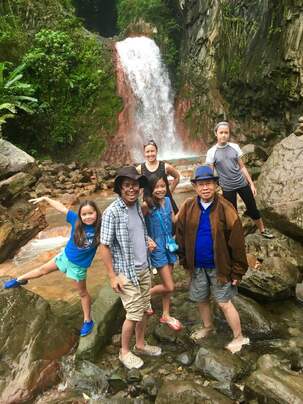
PicturePulang Bato Falls
​Last August, my wife Sylvia and I caught the travel bug. She and I explored Germany, France and the UK for a week. Then she took off to Costa Rica for a two week Spanish immersion course. Then on Christmas day, our family flew out to visit my parents in the Philippines, the country of my birth. 

Even though I was born and raised in the tropical islands in the first seventeen years of my life, it was fascinating to see me go through my own a culture shock. After living in the southwest desert for three years (Albuquerque), it was a sight to see the abundance of water. I have lived in the east coast (Virginia) and the west coast (San Francisco bay area), both places close to water, but Philippines’ relationship with water is different. Water seems to gush abundantly everywhere: from the ground through springs, hot springs, rivers, waterfalls, and lakes. After being away for 27 years, somehow I have forgotten odd abundance of water in the islands (not to mention the humidity). 

As a cultural hybrid, I’ve always been caught in the in-between, deprived of certainty around my cultural identity. My wife was way more astute in noticing the cultural differences during our visit, for instance, the transgression of boundaries between groups of people. Due to their colonial history, Filipinos are experts in cultural hybridity, of constantly being "in-between." It made her feel uncomfortable, but only at first (her blog here). Certainty is thrown out the window, but something new gets revealed, such as discovering a new cultural lens to see the world, or perhaps a new insight. 

As someone interested in learning new cultures, I envy millennial vloggers who travel and create documentaries. I hope to do heed Vincent Van Gogh’s invitation to go out into deeper waters, into the Sea-of-Life, to fully live out one’s sacred call towards risk and adventure, and integrate a new perspective. 

The late Anthony Bourdain says this sacred invitation well: “If I'm an advocate for anything, it's to move. As far as you can, as much as you can. Across the ocean, or simply across the river. The extent to which you can walk in someone else's shoes or at least eat their food, it's a plus for everybody. Open your mind, get up off the couch, move.”

Bourdain adds: “Maybe that's enlightenment enough: to know that there is no final resting place of the mind; no moment of smug clarity. Perhaps wisdom... is realizing how small I am, and unwise, and how far I have yet to go.”

Travelling is a good way to train our brains to learn to cope with the experience of disorientation. It is a humbling experience; it makes us realize that our cultural perspective is just one among many.

Forward>>

    Donnel Miller-Mutia

    Join me in chewing the cud on mindful communication and relationships, self-awareness, spirituality and mythology. 

    A "bangka" is a native Filipino canoe with outriggers. This blog invites its readers to embark on the journey towards the Sea of Life.

    Archives

    October 2025
    August 2025
    May 2024
    March 2024
    May 2021
    March 2021
    June 2020
    January 2020
    December 2019
    November 2019
    October 2019
    February 2019
    January 2019

    Categories

    All

    RSS Feed

Picture
​Donnel Miller-Mutia
- chaplain, grief support specialist, relationship educator, artist
- shares arts and skills to aid your growth in the fullness of life. 

Contact Donnel
Proudly powered by Weebly
  • Home
  • Wisdom Stories
    • Brother Bear >
      • River
      • Desert Stream
      • Raft
      • 4 Seasons
      • Guest Ghost House
      • Bamboo
      • Kintsugi
      • Sea of Life
      • Facing Fear
      • Oak Tree
      • Fearful Candle
      • Still Small Voice
      • 4 Elements
      • Butterfly
      • Carrot Egg Coffee
      • Four Candles
      • Bottle
      • Time and Love
      • Maybe
      • Dam
      • Tigers
      • World Mirrors the Heart
      • Prodigal Son
      • Prism & Rainbows
      • The Lotus
    • Leaven
    • Samurai & Monk
    • Fish Searching the Ocean
    • Great Pearl
    • Labyrinth
    • The Woodcarver
    • Good Shepherd
    • Peace in Stormy Sea
    • Milk to Butter
    • Dragon
    • Sower
    • Cracked Jar
    • Mustard Seed
    • The Well
    • Tea
    • Golden Cage
    • Four Directions
    • Train of Life
    • Two Wolves
    • Samaritan
    • Oak and Bamboo
    • A Meadowlark
    • Dry Bones
    • Table
    • Angry Man
  • Chaplaincy
    • Healthcare Staff >
      • When to call a chaplain
      • Spiritual Care for Staff
      • Spirituality
      • Resilience Resource
      • Grief Resources >
        • Grief & the Pandemic
      • Breathe
      • Chaplain's Tea
      • Prayers for Staff
      • Silent Prayer
      • Prayer Requests
      • Blessing of Hands
      • Blessing of Workspace
      • Imposition of Ashes
      • Holiday Box Project
    • Resources for Spiritual Care Groups >
      • Learning Modules
      • Art Projects >
        • Healing Hands Mandala
      • Mindful Gestures
      • Community Singing >
        • Healing Breath
      • Highs & Lows Ritual
  • Art & Music
    • Prayer Chants
    • Van Gogh Spirituality
    • Couple Resources >
      • Couples Class >
        • Prepare Enrich Class